“Never stop running. It gives us everything.” – Kathrine Switzer
On May 1, I ran the Vancouver Half-Marathon. The results were good – great for me, with a personal best of 1:48 – and the weather was absolutely gorgeous. I couldn’t have asked for a better day, or for better friends to share it with.
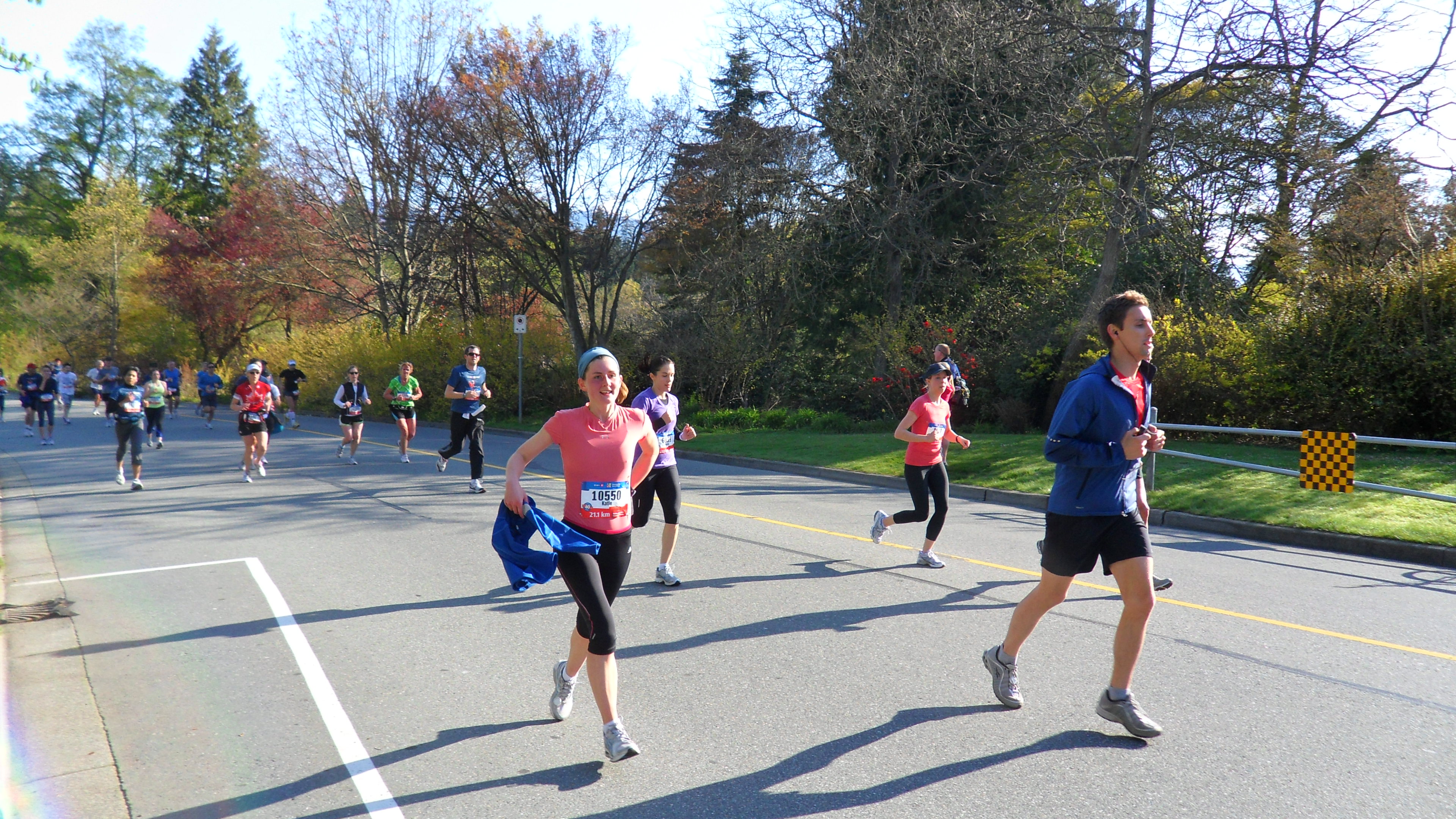
I will come back to issues of time and performance, as this is something worth discussing, but first I need to devote a moment to Kathrine Switzer, because without her, it’s entirely possible that my running “career” would be very, very different.
Kathrine Switzer and her husband, Roger Robinson, also a world-class runner, English professor, and author gave a joint presentation at the marathon fair on the Saturday preceding the Vancouver Marathon. Roger talked about the marathon’s origins in Greek history – there’s a film about this for which he wrote the screenplay and the title of which I, of course, did not write down and now cannot remember – and literary representations of running. In fact, he’s written a book on the subject – Running in Literature: A Guide for Scholars, Readers, Runners, Joggers and Dreamers (a copy of which I am currently enjoying very much).
Kathrine told her own story. She was the first woman to run the Boston marathon as a registered participant, in 1967. At that time, women did not run marathons. Common wisdom, backed up as it always is by this or that tidbit of skewed scientific evidence, held that a woman who ran any significant distance would lose her femininity at best and her uterus at worst. It wasn’t healthy, it wasn’t proper, it wasn’t done. But Kathrine did it; she finished the race (despite the race director’s attempts to physically remove her – an incident which was captured on film and resulted in one of the most affecting photo series I’ve ever seen) and from that day on campaigned tirelessly for women’s right to run, for women’s ability to run, for inclusion, empowerment, passion, and – the holy grail – the women’s Olympic marathon, which was finally introduced in Los Angeles in 1984. For the complete telling of this amazing story, I’ll refer you to Kathrine’s website first:
http://www.kathrineswitzer.com/life.shtml
And then to her book, Marathon Woman (2007), which I would highly and heartily recommend to anyone, runner or not.
To return to the question of time, placing, performance, and competition, I’ll touch on an interesting point that Kathrine raises in her book. In her efforts to promote the female capacity for athletic performance in general and the women’s marathon in particular, she comes to the realization that, in order to be taken seriously by male officials, she will have to prove that she is not only a skilled campaigner and organizer, but a skilled athlete as well. She’ll have to run fast. And she does, winning the 1974 New York marathon and posting one of the best times in the world in the 1975 Boston marathon. I don’t disagree with her stance at all, given the situation she was working within, but the idea, ripped from its historical context, that to contribute to a sport one must be “good” at it gives me pause. I don’t think this is necessarily true.
I would very much like to DO something with my running; I love it and will always do it, but I would also like to do something with it. While this “something” has yet to be determined exactly, I’m sure it will require, at some point, others to take me and my ideas seriously. However, I am hardly a world-class runner. My performances are certainly respectable, better than average even (sometimes), but hardly noteworthy. Of course, I train as much as I can and am sure I’ll continue to improve. Whether I will ever move past “better than average on a good day, but hardly noteworthy” remains to be seen, however. So I’ve made a decision – unfortunately not yet well enough formed to provide even a blog entry with closure, but a decision nonetheless. Instead of worrying about what role performance might or might not play in my doing of this fabled something, my goal is to develop my own take on the sport, its value, its benefits, and its uses, as well as its quirks and eccentricities and characters (which are many, varied, and utterly fabulous…stay tuned for some case studies). I would argue that it’s possible for great contributions to be made to a sport by anyone who chooses to do so, because there is far more to sport than elite performance.


 Dispatches from the middle
Leave a reply to Katie Petersen Cancel reply