After careful consideration and long deliberation, I got some! A pair of “Vibram Fivefinger Bikilas.” Toe shoes!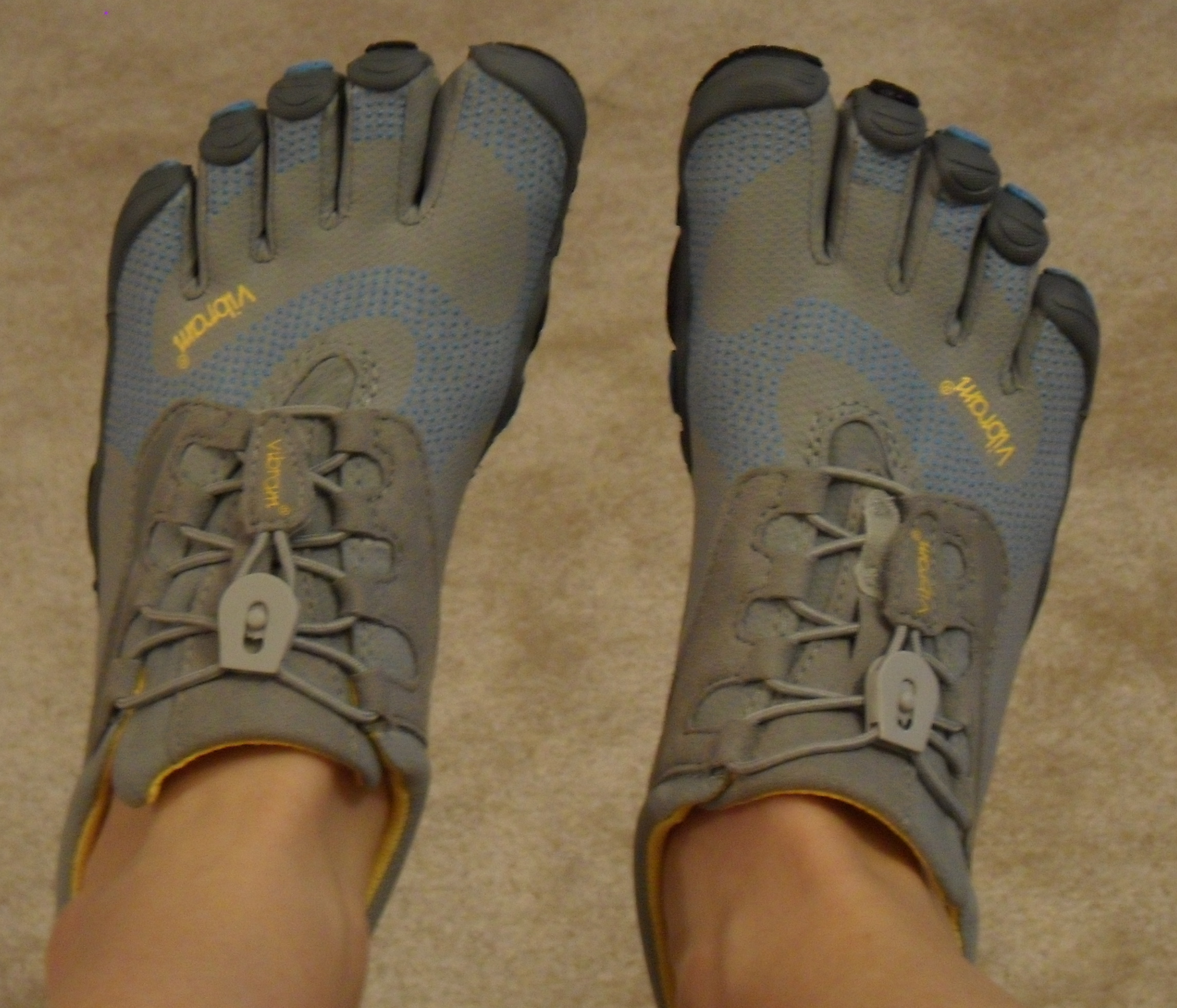 Now, “Vibram” sounds like something I’d hide in my sock drawer, “Fivefinger” would make sense, except that they’re for your feet, and “Bikila” sounds like I should be drunk after slightly less than two. Despite the semantic incongruities, however, I couldn’t resist a nice blue pair of those strange looking, slipper-like shoes that people always end up staring at for just a little bit too long. I’ve struck up a lot of conversations because of these shoes – and the wearers invariably offer high praise. The simple fact of ownership, however, will do nothing for me (except perhaps to garner a couple of those curious and covetous stares).
Fivefingers can be worn for all sorts of different activities – running, in the gym, some are meant for wearing in water, everyday use, comfy shoes on the airplane etc. Personally, my intention is to run in them, the idea being that they simulate barefoot running while providing some protection for the soles of your feet. There are lots of arguments for the benefits of barefoot running – how it strengthens your feet, improves your form, and, in doing so, makes you an all-around better and more injury-resistant runner. Christopher McDougall makes a compelling case for barefoot running in his book Born to Run (which I would highly recommend). It’s very true that human feet and legs were not designed, so to speak, to be wrapped in hundreds of dollars worth of fabric, foam, and strategically-placed air pockets before running. Though I’m not an expert on the physiology of it all, it makes sense that coddling our feet by providing an unnatural amount of cushioning and artificial stabilization could result in weaknesses that could then, in turn, result in injury.
However, just as our feet weren’t “meant” to run in Asics, our feet also weren’t “meant” to run on concrete. That doesn’t stop us though. I think running shoes provide a lot of necessary protection, especially against impact, and especially over longer distances. So, while I’m eager to give the fivefingers a try, and I’m curious to learn more about the benefits of barefoot running, I’m not about to turn in my Asics (why am I not being paid for advertising here?!). From what I’ve read, the fivefingers take a lot of getting used to – best to start out with shorter runs and on soft surfaces like grass – and simply do not provide enough support to be comfortable over distances of more than approximately 10 km. This would make sense to me. Mind you, I’ve seen people run marathons wearing them. I’ve seen people run marathons barefoot (which is just gross, given the chunky, slimy film of banana, gel, water, wrappers, and mashed up paper cups coating the road for a good kilometer after every aid station). Ethiopian runner Abebe Bikila (where the name actually comes from) won the 1960 Olympic marathon barefoot. And in Rome no less, which means cobblestones! Thus began Ethiopia’s dominance in long-distance running, but that’s another story.
As with every aspect of running, then, we’ll just have to see how the shoes go. It’ll be an individual thing, an experiment; it might work, it might not. Either way, I very much enjoy being able to really feel the ground I’m walking/running on. It’s a much more intimate way to move through one’s environment, and I’m excited to explore it!
 Dispatches from the middle
Leave a comment